Urine Diagnostics / Urine Test Strips / Portfolio Urine Test Strips / Blood
back to portfolio
| Test principle | |
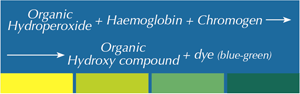 |
The test paper is impregnated with tetramethylbenzidine and an organic hydroperoxide. The peroxidative effect of the haemoglobin and myoglobin oxidises the chromogen to form a blue-green dye, which causes the yellow test paper to turn green. |
| Intact erythrocytes lyse on the test pad. The haemoglobin released by the cells causes a change in colour, visible green dots appear in the surroundings of the erythrocytes. The haemoglobin dissolved in urine (lysed erythrocytes) gives a homogeneous green colour. | |
| Sensitivity |
| The test pad detects approx. 0.015 - 0.03mg free haemoglobin/dl urine.The practical sensitivity to erythrocytes is 5 to 10 erythrocytes/µl. |
| Specifity |
| The test specifically reacts to haemoglobin and myoglobin. |
| Sources of errors |
|
| Clinical significance |
Haematuria, the excretion of intact erythrocytes in urine, is always a serious symptom and requires careful clarification of the cause. In haemoglobinuria, free haemoglobin (lysed erythrocytes) occurs in urine. Myoglobinuria is usually caused by injured muscles or muscle necrosis (myonecrosis).Macrohaematuria can be detected with the naked eye due to the red coloration of the urine (blood contents > 0.5 ml blood/l, > 2500 erythrocytes/µl). Certain medicines (such as pyrazolones, phenazopyridines) or dyes (such as after eating beetroot) can also cause a red coloured urine. Haematuria can occur in many diseases. These mainly concern:
|
Before you fill out the form and submit, please read our privacy policy!